
So far, mid-August has demonstrated that Washington is continuing to solidify a centralized trade architecture by extending national security protections to high-tech sectors, issuing a Presidential Proclamation under Section 232 imposing 15% to 100% tariffs on foreign drones and components.
Simultaneously, a landmark federal decision by the U.S. Court of International Trade upheld the administration's suspension of the $800 de minimis exemption, permanently altering cross-border ecommerce by subjecting low-value parcels to formal customs entries.
As macro-economic data revealed that the U.S. weighted-average statutory tariff rate settled at 11.0%, North American trade faced heightened friction, prompting Canadian and U.S. officials to hold emergency weekend negotiations in Washington to head off a pending 50% Section 338 tariff deadline on Canadian goods.
Below, Freight Right examines the implications of these recent events for ocean, air and freight markets going into September.
China-U.S. Ocean Freight Market:
CEA to USWC: Market rates are hovering around $7,000 to $7,500 per forty-foot equivalent unit (FEU). However, promotional rates are available, bringing actual usable market levels down to roughly $5,700-$6,300 per container. Overall, rates for the West Coast remain stable to slightly softer due to these discounted options.
CEA to USEC: Market rates sit firmly between $9,800 and $11,000 per FEU. Unlike the West Coast, virtually no promotional or discounted rates are accessible for East Coast, Gulf Coast, or inland destinations, forcing shippers to book at near-full market price.
Freight Right’s Lowest Rate indicators show that importers can find the latest spot ocean rates as low as $5,200 from China to the U.S. West Coast and $6,850 from China to the U.S. East Coast. Talk to your freight forwarder about options available to you.
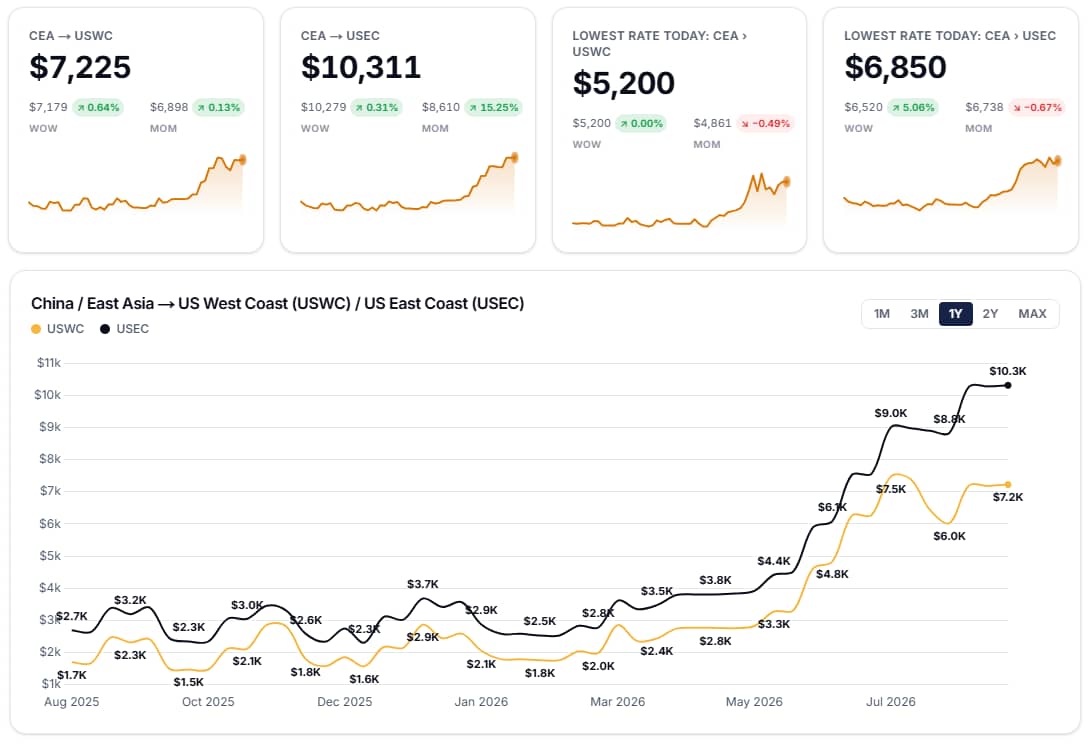
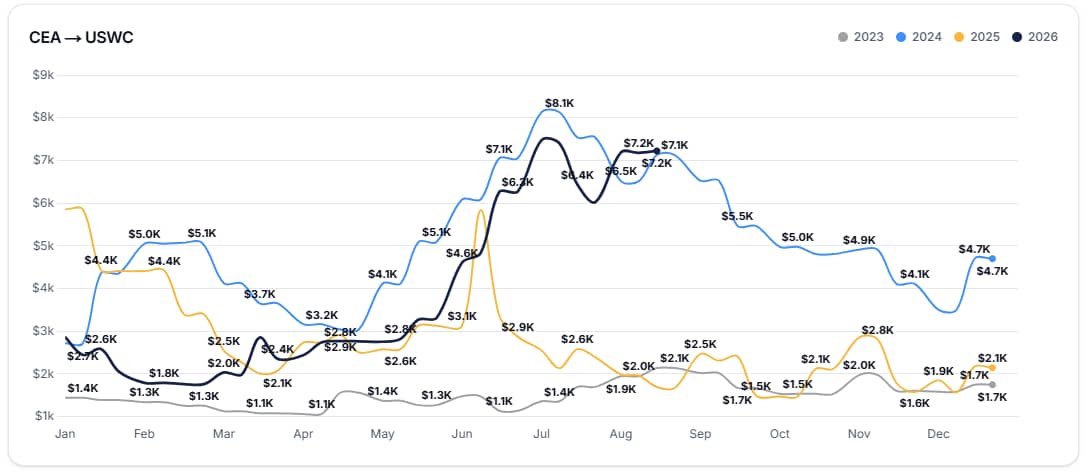
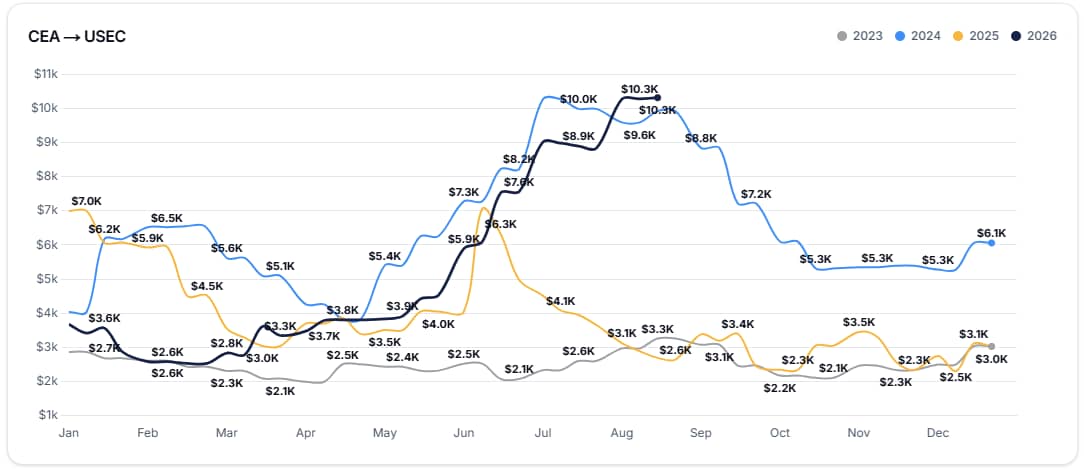
The market is currently in a brief late-August lull, but rate floors are expected to remain solid. Carrier capacity cuts should successfully prevent a major rate collapse, ensuring spot rates stay near elevated levels through the end of the month.
Heading into September, minor downward adjustments of a few hundred dollars may occur if overall volumes drop slightly, but no drastic rate cuts are anticipated. Carriers will continue using blank sailings as a lever to preserve high rate baselines.
China-U.S. Air Freight Market:
CEA to USWC: Rates eased toward the end of last week after a short-lived increase early in the week. Typhoon Dolphin disrupted flight schedules and temporarily tightened available capacity, pushing rates higher as cargo backlogs accumulated. Once schedules normalized and the backlog cleared, softer underlying demand allowed pricing to retreat.
Current week quotes into LAX and SFO generally sit around $5.00-$6.30/kg for standard-density cargo, depending on origin, carrier, routing, and shipment configuration.
CEA to USEC: Rates followed a similar pattern. Temporary capacity disruption from Typhoon Dolphin created upward pressure early last week, but rates softened later as delayed cargo moved through the network and demand moderated.
Pricing in JFK is generally around $6.25-$7.65/kg for standard-density cargo, with carrier and routing choices accounting for much of the spread. Overall, the market has moved back toward more stable conditions following last week's weather-driven volatility.
Air freight rates from China to the U.S. are expected to remain relatively stable this week as the market has absorbed the disruption caused by Typhoon Dolphin, and backlogs have been cleared. Softer demand should limit carriers’ ability to push through meaningful rate increases, keeping both West and East Coast pricing within a narrow range. Barring new weather events or capacity disruptions, any upward pressure would need to come from sustained demand growth rather than short-term operational issues.
This story was produced by Freight Right and reviewed and distributed by Stacker.


